About ROMA’s project
The oscillations' monitoring and analytics (ROMA) project is operated by the University of Mexico (UNAM, in Spanish) located in Mexico City, the Michoacan State University (MSU) located in Morelia, and the Nuevo Leon State University (NLSU) located in Monterrey. ROMA is supported by the Power Information Technology Laboratory at the University of Tennessee, in special by the FNET/GridEye project. ROMA is integrated by a time-synchronized wide-area monitoring system (WAMS) based on frequency disturbance recorders (FDRs) and phasor measurement units (PMUs) that enable to provide real-time information of the power system dynamics, such as their frequency, phase angle, and voltage which are measured at conventional 120 V outlets. All measurements are continuously transmitted via the Internet to the ROMA server hosted at the Michoacan State University and collected through a real-time collection of phasor measurements from the low voltage grid into a complex phasor data concentrator (PDC) powered by an open source phasor data concentrator, the OpenPDC administered by the Grid Protection Alliance.
Research Applications
By harnessing the potential of a realistic WAMS in Mexico, the ROMA’s project specifically targets to enrich research and provide solutions in power system applications concerning PMUs and data analytics. Specifically, such as:
- Wide-area frequency visualization and graphic display.
- Wide-area angle visualization and graphic display.
- Coherency detection by dynamic clustering from wide-area frequency and angle measurements.
- Angle stability situational awareness via spectral analysis, localization of oscillation sources, and detection of low-frequency oscillations and phase angle differences.
- Angle stability indices via real-time inter-area oscillatory mode identification.
- Online data recovery for Multi-channel PMU data processing.
- High-dimensionality PMU data reduction through big data analytics.
Tools Developed
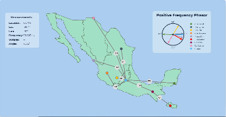
Positive Frequency Phasor
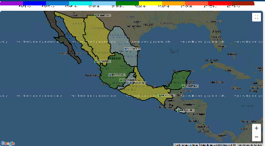
Frequency Zones Monitoring
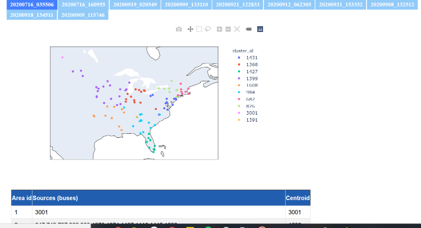
CAPS-D
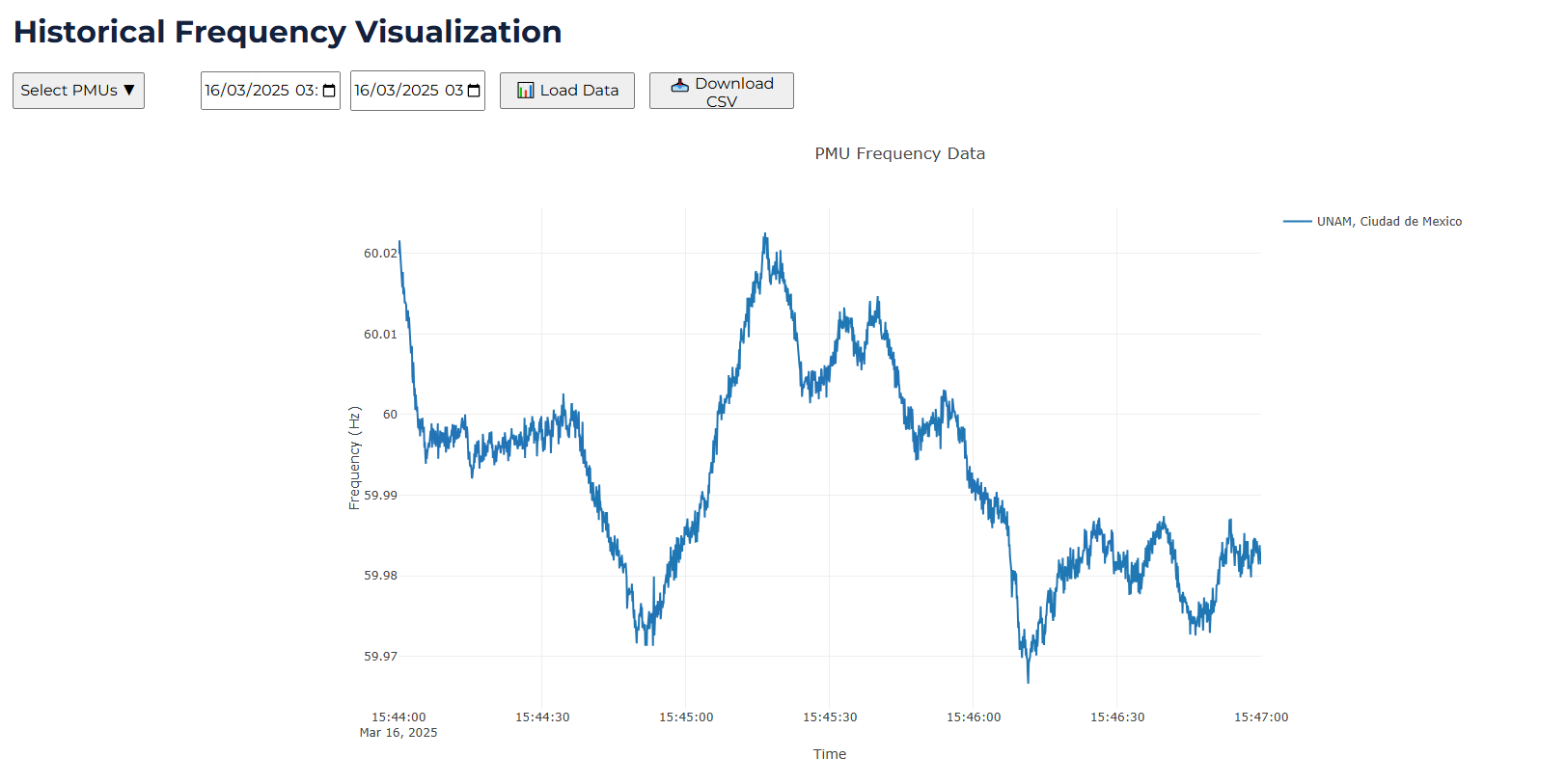
Historical Data
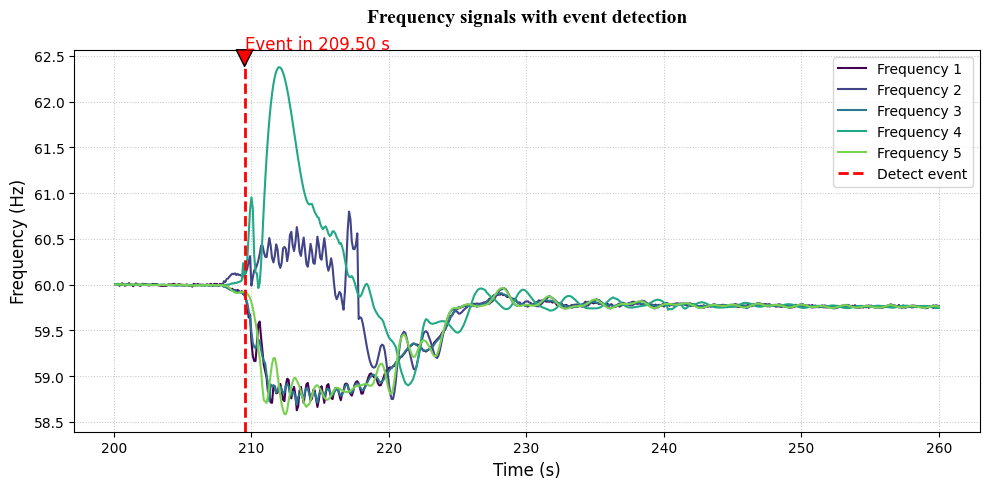
Event detection
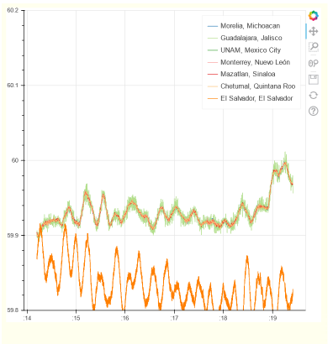
PMU Real-time Signals
Team Members


Dr. Mario Roberto Arrieta Paternina
Dr. Mario Roberto Arrieta Paternina received the B.Eng. and M.Eng. degrees from the National University of Colombia, in 2007 and 2009, respectively, and the D.Sc. degree from Cinvestav, Guadalajara, Mexico, in 2017, all in electrical engineering. He was a Visiting Scholar at Rensselaer Polytechnic Institute (RPI) in 2016. He joined the Department of Electrical Engineering at Universidad Nacional Autónoma de México (UNAM), in 2017. His current research interests include modeling, simulation, control, and digitalization of resilient electric energy transmission and distribution networks. Dr. Arrieta-Paternina is a member of the Mexican Research System and the IEEE Power & Energy Society.
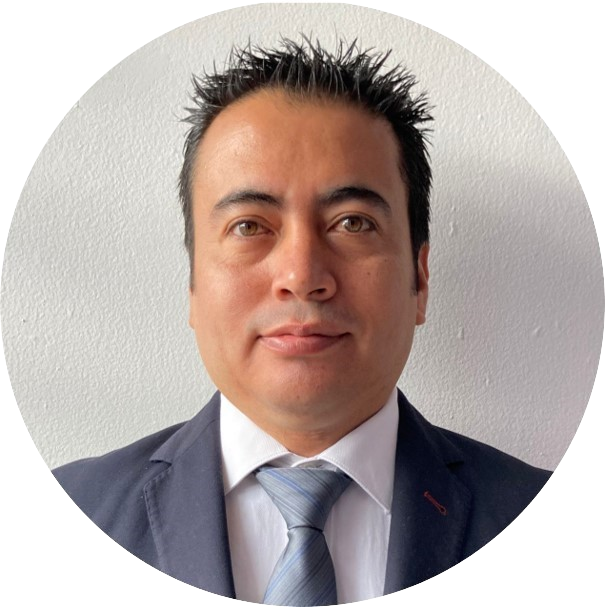
Dr. Alejandro Zamora
Alejandro Zamora obtained his B.S. and M.Sc. in Electrical Engineering from Universidad Michoacana de San Nicolas de Hidalgo (UMSNH), Morelia, Mexico, in 2005 and 2008, respectively. He joined the Electrical Engineering Faculty, UMSNH, in 2008, where he is a full-time Professor. He received a Ph.D. degree from CINVESTAV-Guadalajara in 2016. He was a visiting scholar at Washington State University in 2015. His current research interests include oscillation monitoring, modal identification, WAMS applications, the operation and control of power systems. Dr. Zamora-Mendez is a member of the Mexican Research System and the IEEE Power & Energy Society.
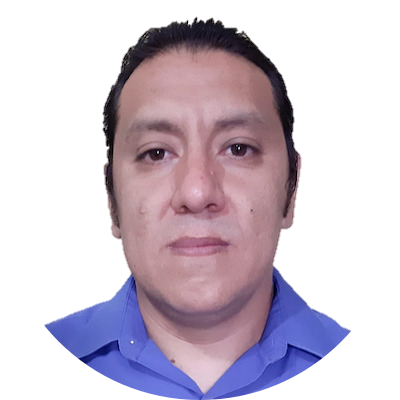
Dr. José Ortiz-Bejar
José Ortiz-Bejar obtained his B.S. and M.Sc. in Electrical Engineering from Universidad Michoacana de San Nicolas de Hidalgo (UMSNH), Morelia, Mexico, in 2005 and 2008, respectively. He is currently associate professor at the Michoacan University of San Nicolás de Hidalgo. He received his Ph.D. in Data Science from INFOTEC, Unidad Aguascalientes in 2020. His research interest centers on Machine Learning applied to Power Systems analysis, Text Categorization, and clustering.

Carlos Andrés Toledo Santos
Carlos Toledo-Santos obtained in 2019 a B.Eng. in Electrical Engineering from Industrial University of Santander with a Cum Laude distinction and participated in an academic exchange at UNAM in 2018. He is an enthusiastic engineer about how the grid will evolve to accelerate the energy transition. His current research and work interest lie in the intersection of power systems and software engineering including renewable energies, WAMPS, power systems analysis and web application development.
Rodrigo Reyes
Rodrigo Reyes obtained his B.S and M.Sc. in Electrical Engineering from National Polytechnic Institute (IPN), CdMx, Mexico, in 2008 and 2014 respectively. From 2009 to 2014 he worked as a power transformer design engineer at IEM. In 2014, he joined the National Center of Energy Control Center (CENACE) to the analysis department. His current research includes modal identification, oscillation monitoring and WAMS applications.

José Luis Zárate Gómez
José Luis Zárate Gómez is currently a student of B.S. in Electrical-Electronics Engineering at Universidad Nacional Autónoma de México (UNAM) since 2017. He is working in the Department of Electrical Engineering developing his social service with the ROMA project. Passionate about innovation and the implementation of renewable energy to the grid, his current interest lies in the battery management systems for power electronics uses.

Francisco Zelaya
Francisco Zelaya received his B.S. degree in Electrical Engineering from Universidad Centroamericana José Simeón Cañas, El Salvador, and his M.Eng. in Power Systems from Universidad Nacional Autónoma de México (UNAM), Mexico, in 2014 and 2019, respectively. He has worked for the national system operator of El Salvador, Unidad de Transacciones (UT), and the regional system operator of Central America, Ente Operador Regional (EOR). He is currently pursuing his Ph.D. degree in Electrical Engineering, from the University of Tennessee, Knoxville, USA. His research areas include power system dynamics, stability, and control, low inertia power systems, and renewable energy.

Luis Mendieta
Luis Alejandro Mendieta Mejia is currently a student in Electrical-Electronics Engineering at Universidad Nacional Autónoma de México (UNAM) since 2016. He is working in the Department of Electrical Engineering developing his social service in the ROMA project. His interest in programming and distribution systems.

José Manuel Ramos Guerrero
José Manuel Ramos (Member, IEEE) received the B.Eng. and M.Eng. degrees in electrical power systems from the National Autonomous University of Mexico (UNAM) in 2022 and 2024, respectively. Since 2024, he has been working towards the Ph.D. degree in Electrical Engineering at UNAM. His areas of interest include the design of electrical machines, interconnection of renewable energy to the grid, and stability of power systems through modal patterns. He has experience in the calculation, sizing, simulation and optimization of low-power wind turbines and transient stability analysis.
Participants